
Myasthenia Gravis Clinical Trial Pipeline: DelveInsight Highlights Major Advances, Transformative Therapies, and 28+ Leading Players Wheeling the Therapeutics Landscape
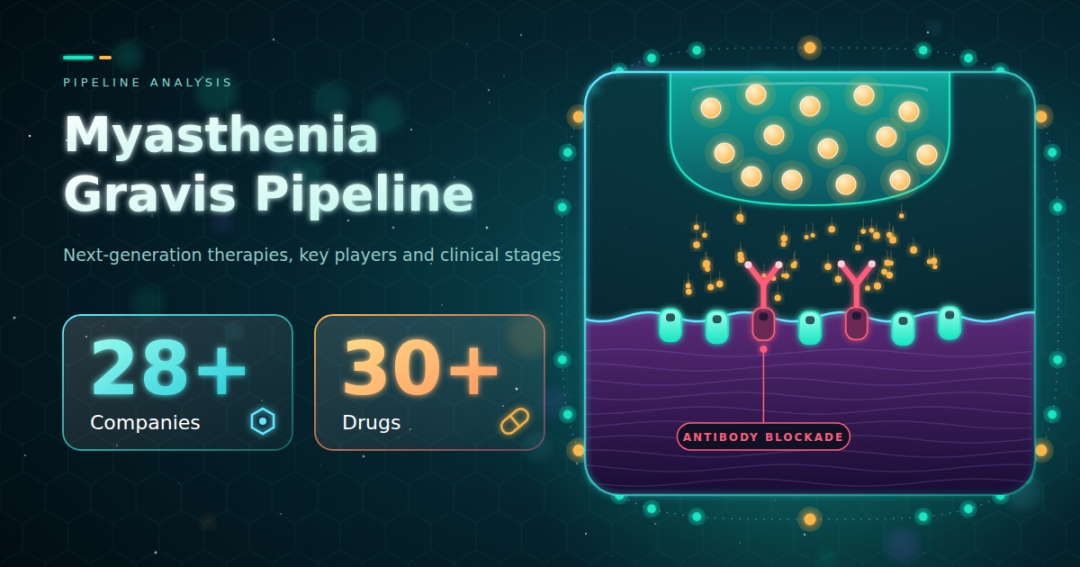
(Albany, US) On October 27, 2026, DelveInsight’s “Myasthenia Gravis Pipeline Insight 2026” report provides comprehensive insights about 28+ companies and 30+ pipeline drugs in the Myasthenia Gravis pipeline landscape. It covers the Myasthenia Gravis Pipeline drug profiles, including clinical and nonclinical stage products. It also covers the Myasthenia Gravis Pipeline Therapeutics assessment by product type, stage, route of administration, and molecule type. It further highlights the inactive pipeline products in this space.
Curious about the latest updates in the Myasthenia Gravis Pipeline? @ https://www.delveinsight.com/sample-request/myasthenia-gravis-pipeline-insight
Key Takeaways from the Myasthenia Gravis Pipeline Report
- On October 4, 2026 – Immunovant presented the design of its Phase III PROPEL trial evaluating imeroprubart (IMVT-1402), an investigational neonatal Fc receptor (FcRn) blocker, in adults with generalized myasthenia gravis (gMG). The study is designed to assess the efficacy and safety of two dose levels compared with placebo, with the aim of reducing pathogenic IgG autoantibodies and improving disease symptoms and daily functioning.
- On October 2, 2026 – Argenx presented clinical and real-world evidence on VYVGART (efgartigimod) at the 2026 American Association of Neuromuscular & Electrodiagnostic Medicine (AANEM) Annual Meeting and Myasthenia Gravis Foundation of America Scientific Session. The presentations included data on sustained treatment effects, outcomes in patients who are acetylcholine receptor antibody-negative, and the potential benefits of earlier treatment in myasthenia gravis.
- On October 2, 2026 – Johnson & Johnson presented additional findings on IMAAVY (nipocalimab) at the same scientific meetings, including two-year follow-up data in adolescents with gMG. The findings showed sustained improvements in daily functioning and muscle strength, alongside reductions in corticosteroid use in some patients. The underlying company announcement was published on September 29, 2026.
- DelveInsight’s Myasthenia Gravis Pipeline report depicts a robust space with 28+ active players working to develop 30+ pipeline therapies for Myasthenia Gravis treatment.
- The leading Myasthenia Gravis Companies include Dianthus Therapeutics, ImmunAbs Inc., Novartis AG, Bristol-Myers Squibb and others.
- Promising Myasthenia Gravis Therapies include NMD670, KYV-101, Inebilizumab, Eculizumab, UCB7665, Efgartigimod, Nipocalimab, TAK-079, RVT-1401 and others.
Want to know which companies are leading innovation in Myasthenia Gravis? @ Myasthenia Gravis Clinical Trials Assessment
The Myasthenia Gravis Pipeline Report provides disease overview, pipeline scenario and therapeutic assessment of the key pipeline therapies in this domain. The Myasthenia Gravis Pipeline Report also highlights the unmet needs with respect to the Myasthenia Gravis.
Myasthenia Gravis Overview
Myasthenia gravis (MG) is a chronic autoimmune disorder of the neuromuscular junction characterized by fluctuating skeletal muscle weakness that worsens with activity and improves with rest. The disease most commonly affects the ocular, bulbar, respiratory, and limb muscles. In most patients, autoantibodies directed against postsynaptic proteins impair neuromuscular transmission, resulting in fatigable muscle weakness. MG develops in genetically susceptible individuals due to an autoimmune response against proteins at the neuromuscular junction. The most common target is the nicotinic acetylcholine receptor (AChR), while other pathogenic antibodies target muscle-specific kinase (MuSK) or lipoprotein receptor-related protein 4 (LRP4). Approximately 10% of patients have an associated thymoma, and disease onset or exacerbation may be triggered by infections, surgery, immunization, medications, or other physiological stressor.
Myasthenia Gravis Emerging Drugs
- Claseprubart (DNTH103): Dianthus Therapeutics
Claseprubart is an investigational, clinical-stage, potent monoclonal antibody engineered to selectively target the classical pathway by inhibiting only the active form of the C1s protein, a clinically validated complement target. Claseprubart is enhanced with YTE half-life extension technology designed to enable a more convenient subcutaneous, infrequently dosed, self-administered injection. Additionally, selective inhibition of the classical complement pathway may lower patient risk of infection from encapsulated bacteria by preserving immune activity of the lectin and alternative pathways. As the classical pathway plays a significant role in disease pathology, claseprubart has the potential to be a best-in-class pipeline-in-a-product across a range of autoimmune disorders with high unmet need. Currently, the drug is being evaluated in the Phase III stage of its development for the treatment of Myasthenia Gravis.
- IM-101: ImmunAbs Inc.
IM-101 is an investigational humanized anti-complement C5 monoclonal antibody developed by ImmunAbs Inc. for the treatment of generalized myasthenia gravis (gMG) and ocular myasthenia gravis (oMG). Administered by intravenous infusion, IM-101 is designed to selectively bind complement component C5 and inhibit its cleavage into C5a and C5b, thereby preventing formation of the membrane attack complex (C5b-9) responsible for complement-mediated damage at the neuromuscular junction. By preserving acetylcholine receptor integrity and improving neuromuscular transmission, the therapy aims to reduce muscle weakness and disease symptoms. Currently, the drug is being evaluated in the Phase I/II stage of its development for the treatment of Myasthenia Gravis.
- Rapcabtagene autoleucel (YTB323): Novartis AG
Rapcabtagene autoleucel (YTB323) is an investigational autologous CD19-directed chimeric antigen receptor (CAR) T-cell therapy developed by Novartis for the treatment of generalized myasthenia gravis (gMG). Manufactured using the proprietary T-Charge™ platform, YTB323 is designed to preserve naïve and stem cell memory T cells, enabling rapid manufacturing while enhancing T-cell expansion and persistence. By targeting and eliminating CD19-expressing B cells, the therapy aims to reduce the production of pathogenic autoantibodies that drive myasthenia gravis. Currently, the drug is being evaluated in the Phase I/II stage of its development for the treatment of Myasthenia Gravis.
- Zolacabtagene autoleucel: Bristol-Myers Squibb
Zolacabtagene autoleucel is an investigational autologous CD19-targeted NEX-T CAR T-cell therapy which is manufactured using the company’s NEX-T™ cell therapy platform, which is designed to enhance T-cell fitness, expansion, and persistence while enabling a streamlined manufacturing process. Following a single infusion, zola-cel selectively targets and eliminates CD19-expressing B cells, including autoreactive B cells that produce pathogenic autoantibodies implicated in MG, with the goal of achieving deep B-cell depletion, immune system reset, and durable disease remission. Currently, the drug is being evaluated in the Phase I stage of its development for the treatment of Myasthenia Gravis.
If you’re tracking ongoing Myasthenia Gravis Clinical trials, this press release is a must-read @ Myasthenia Gravis Treatment Drugs
The Myasthenia Gravis Pipeline report provides insights into:-
- The report provides detailed insights about companies that are developing therapies for the treatment of Myasthenia Gravis with aggregate therapies developed by each company for the same.
- It accesses the Different therapeutic candidates segmented into early-stage, mid-stage, and late-stage of development for Myasthenia Gravis Treatment.
- Myasthenia Gravis Companies are involved in targeted therapeutics development with respective active and inactive (dormant or discontinued) projects.
- Myasthenia Gravis Drugs under development based on the stage of development, route of administration, target receptor, monotherapy or combination therapy, a different mechanism of action, and molecular type.
- Detailed analysis of collaborations (company-company collaborations and company-academia collaborations), licensing agreement and financing details for future advancement of the Myasthenia Gravis market.
Myasthenia Gravis Companies
Dianthus Therapeutics, ImmunAbs Inc., Novartis AG, Bristol-Myers Squibb and others.
Myasthenia Gravis Pipeline Report provides the therapeutic assessment of the pipeline drugs by the Route of Administration. Products have been categorized under various ROAs such as,
- Oral
- Intravenous
- Subcutaneous
- Parenteral
- Topical
Myasthenia Gravis Products have been categorized under various Molecule types such as,
- Recombinant fusion proteins
- Small molecule
- Monoclonal antibody
- Peptide
- Polymer
- Gene therapy
From emerging drug candidates to competitive intelligence, the Myasthenia Gravis Pipeline Report covers it all @ Myasthenia Gravis Market Drivers and Barriers, and Future Perspectives
Scope of the Myasthenia Gravis Pipeline Report
- Coverage- Global
- Myasthenia Gravis Companies- Dianthus Therapeutics, ImmunAbs Inc., Novartis AG, Bristol-Myers Squibb and others.
- Myasthenia Gravis Therapies- NMD670, KYV-101, Inebilizumab, Eculizumab, UCB7665, Efgartigimod, Nipocalimab, TAK-079, RVT-1401 and others.
- Myasthenia Gravis Therapeutic Assessment by Product Type: Mono, Combination, Mono/Combination
- Myasthenia Gravis Therapeutic Assessment by Clinical Stages: Discovery, Pre-clinical, Phase I, Phase II, Phase III
Discover what’s next for the Myasthenia Gravis Treatment landscape in this detailed analysis @ Myasthenia Gravis Emerging Drugs and Major Players
Table of Contents
- Introduction
- Executive Summary
- Myasthenia Gravis: Overview
- Pipeline Therapeutics
- Therapeutic Assessment
- Myasthenia Gravis – DelveInsight’s Analytical Perspective
- Late Stage Products (Preregistration)
- Claseprubart (DNTH103): Dianthus Therapeutics
- Drug profiles in the detailed report…..
- Mid Stage Products (Phase II)
- IM-101: ImmunAbs Inc.
- Drug profiles in the detailed report…..
- Early Stage Products (Phase I/II)
- Drug profiles in the detailed report…..
- Preclinical and Discovery Stage Products
- Drug name: Company name
- Drug profiles in the detailed report…..
- Inactive Products
- Myasthenia Gravis Key Companies
- Myasthenia Gravis Key Products
- Myasthenia Gravis Unmet Needs
- Myasthenia Gravis Market Drivers and Barriers
- Myasthenia Gravis Future Perspectives and Conclusion
- Myasthenia Gravis Analyst Views
- Myasthenia Gravis Key Companies
- Appendix
About Us
DelveInsight is a leading healthcare-focused market research and consulting firm that provides clients with high-quality market intelligence and analysis to support informed business decisions. With a team of experienced industry experts and a deep understanding of the life sciences and healthcare sectors, we offer customized research solutions and insights to clients across the globe. Connect with us to get high-quality, accurate, and real-time intelligence to stay ahead of the growth curve.
Media Contact
Company Name: DelveInsight Business Research LLP
Contact Person: Yash Bhardwaj
Email: Send Email
Phone: 09650213330
Address:304 S. Jones Blvd #2432
City: Albany
State: New York
Country: United States
Website: https://www.delveinsight.com/report-store/myasthenia-gravis-pipeline-insight


